
News
CATHOLICOS ARAM I CALLS FOR STRONGER INTERFAITH COOPERATION AT ASTANA SUMMIT

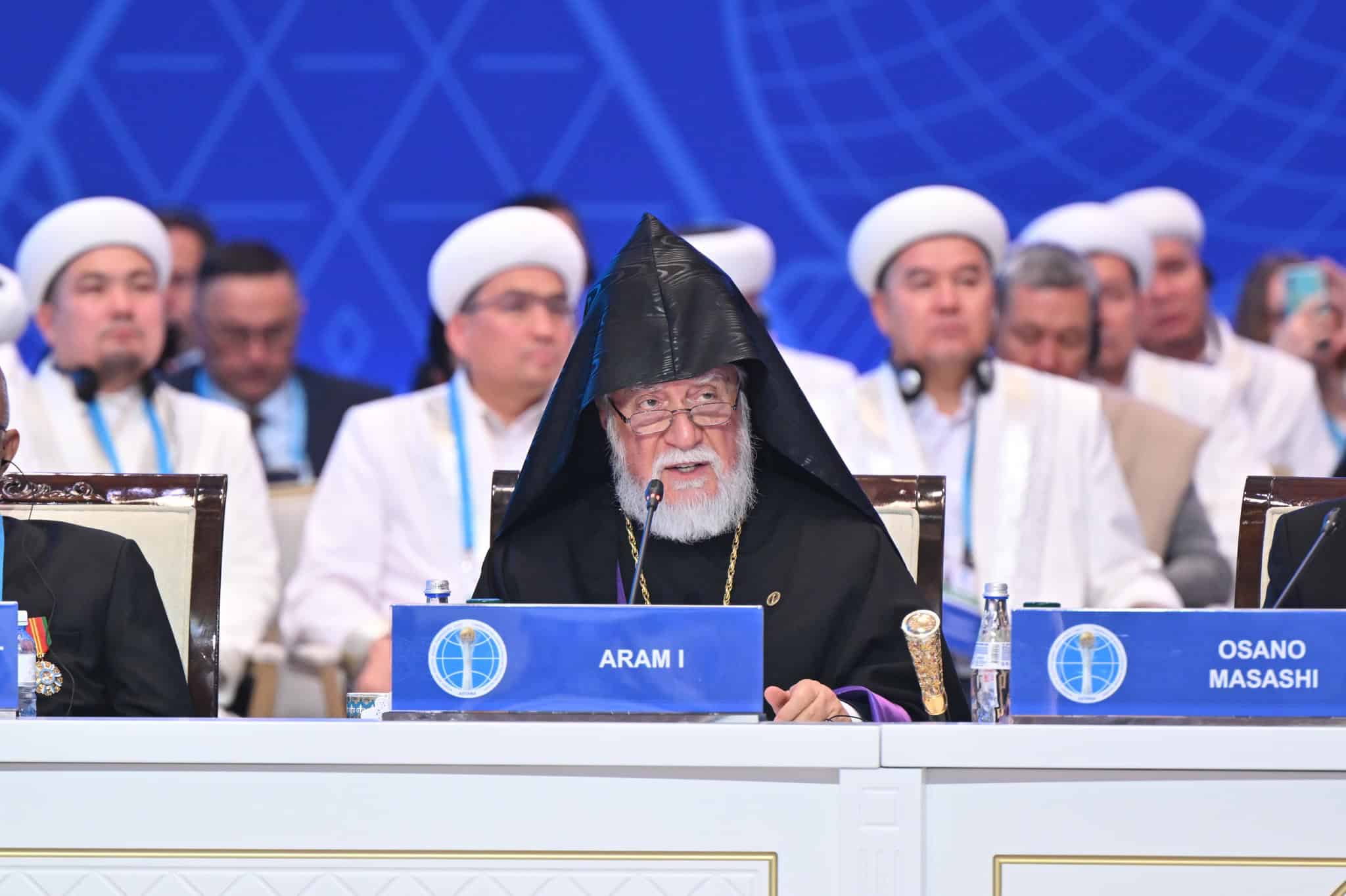
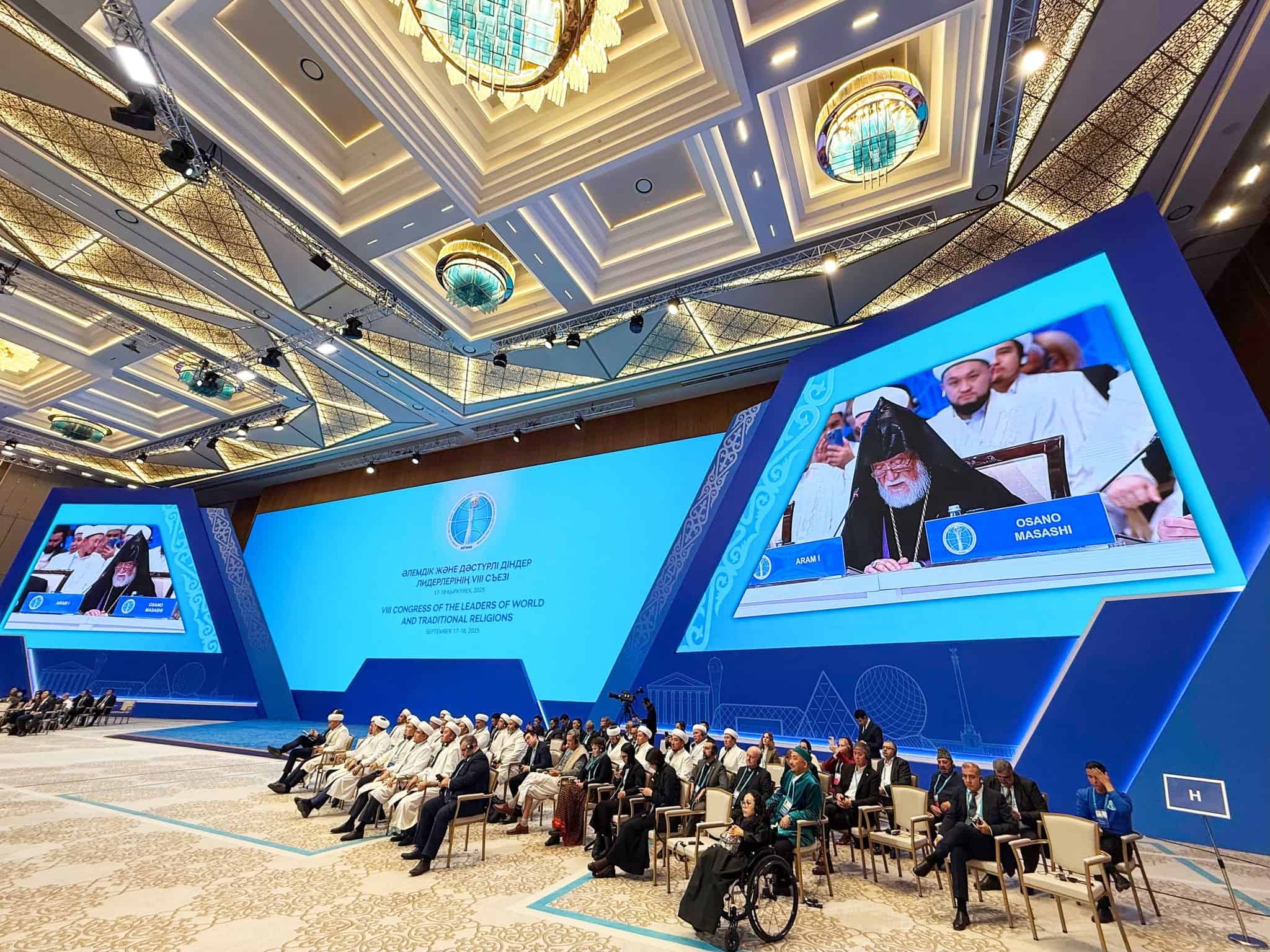
During the recent International Interfaith Summit in Astana, Kazakhstan, on September 17-18, His Holiness Aram I, Catholicos of the Great House of Cilicia, emerged as one of the leading voices urging deeper cooperation among religious communities and the defense of fundamental human values in a troubled world.
In his keynote address at the opening session, the Catholicos welcomed Kazakhstan’s initiative to host and expand interfaith dialogue, stressing that conversations between religions must evolve into concrete cooperation. He said that the agenda of interreligious dialogue must correspond to the conditions of today’s world, while at the same time providing the opportunity to know and respect one another, avoiding approaches that seek to impose unilateral viewpoints and ways of life.
“In today’s world, marked by grave crises, contradictions, and tensions—where rights and justice are too often sacrificed to authoritarian powers—religions cannot remain indifferent,” His Holiness declared. “They are called to serve as bridges and mediators.”
On the sidelines of the summit, Aram I held a series of high-profile meetings. With Cardinal George Jacob Kovakattu, personal representative of Pope Francis and head of the Dicastery for Interreligious Relations, he examined the close cooperation between the Catholicosate of the Great House of Cilicia and the Vatican. His Holiness also discussed the developing relationship between the Vatican and Azerbaijan, highlighting Azerbaijan’s policies and actions towards the Armenians of Artsakh and our historical-cultural monuments, which in no way correspond to either historical or present-day realities. The Catholicos also recalled, in this regard, a conference held some months earlier at the Pontifical Gregorian University in Rome, where unfortunately the Armenian presence in Artsakh had been misrepresented with false information.
On these issues, and particularly regarding Vatican-Azerbaijan relations, Cardinal Kovakattu provided the Catholicos with essential information, while also offering clear explanations on certain matters.
The Catholicos then presented two proposals to the Vatican’s representative:
a) He said that the Armenian Church would be greatly gratified if the Vatican were to continue reminding both Azerbaijan and the international community of the vital importance, in accordance with international law, of preserving intact Armenian churches and historical-cultural monuments.
b) He also urged that every possible measure be pursued to secure the prompt release of the political and national leaders of Artsakh who are currently imprisoned by the Azerbaijani authorities in Baku.
In talks with Russian Patriarch Kirill, the Catholicos stressed the historical bonds between the Armenian and Russian Churches and called for further collaboration. The two spiritual leaders also addressed urgent issues such as the plight of Armenian prisoners in Baku and the protection of Artsakh’s religious and cultural heritage under Azerbaijani control, with Aram I appealing for Russia’s active mediation. His Holiness and the Patriarch’s dates back to their early days as clergymen fifty years ago.
With Patriarch Theophilos III of Jerusalem, he underlined the importance of strengthening inter-Christian cooperation in the Holy City, especially in light of difficulties faced by the Armenian Patriarchate, including disputes over property near the “Cow’s Garden.” The two leaders, long-time colleagues from the World Council of Churches and the Middle East Council of Churches, reaffirmed their commitment to mutual support.
Further meetings included discussions with Dr. Mohammad Mehdi Imanipour of Iran on continuing three decades of Armenian-Iranian interreligious dialogue, and with Judge Mohamed Abdelsalam, Secretary-General of the Muslim Council of Elders, who invited Aram I to address an upcoming gathering on Gaza in Cairo.
In addition, Aram I granted interviews to Kazakh and international media, where he reiterated his call for interfaith cooperation based on moral values and shared responsibility for global challenges such as climate change, genocide prevention, and human rights.