

News
HOW DID THE CONICAL DOME BECOME THE QUINTESSENTIAL MARKER OF THE ARMENIAN CHURCH?

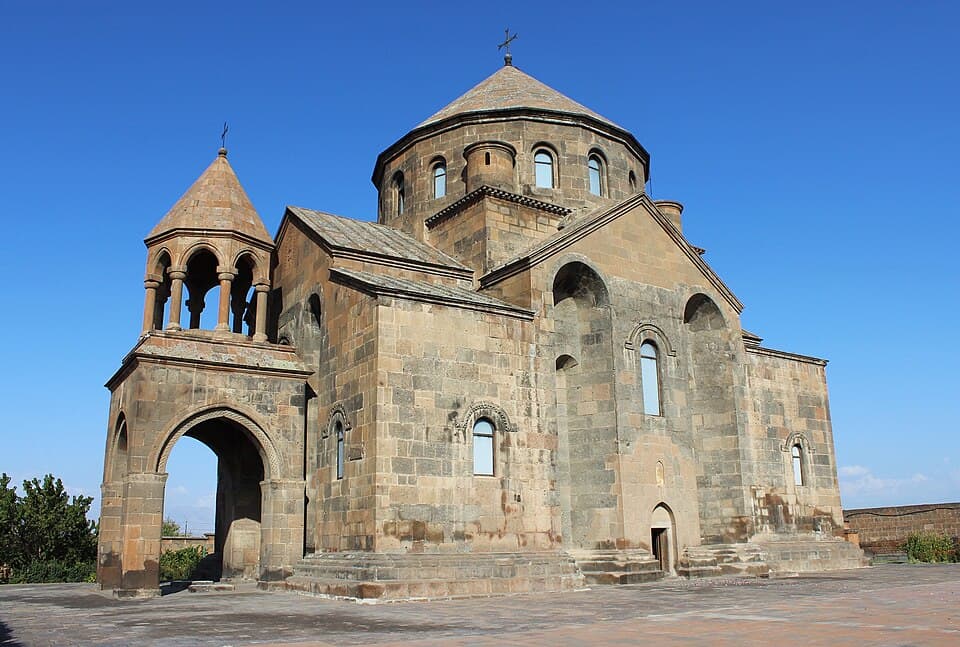
Soon after Armenia became the first state to adopt Christianity in 301, its architects developed a new sacral architecture to accommodate the liturgical requirements of the new faith, with a liturgy that made larger indoor spaces necessary, unlike the pagan temples, which essentially functioned as repositories of the sculptures of gods.
In medieval Armenian church architecture, the most characteristically outstanding feature became the conical dome. There is uncertainty about the origins of the dome, which Armenian architecture historian Toros Toramanian traces back to Persian architecture. In the early literature, we find an indistinct use of khoran/խորան (canopy) and gmbet/գմբէթ (dome).
While the terminological ambiguity may be confusing, the semiotics are the same: the church, a meeting place of the faithful, is a symbol of the kingdom of heaven. This is represented by the dome, the absence of which by the 6th-7th centuries had become almost inconceivable in Armenian church architecture.
Toramanian has indicated that the conical dome represents the summit of Mt. Ararat, later also mimicked by the cowl (veghar) worn since at least the 11th century by the celibate priests of the Armenian Apostolic Church, yet there is no evidence to corroborate this hypothesis. As the Armenian studies scholar Robert W. Thomson has noted, ancient Armenian authors did not dwell much on the symbolism of art and architecture beyond generalities.