

News
Birth of Vardges Petrosian (August 9, 1932)

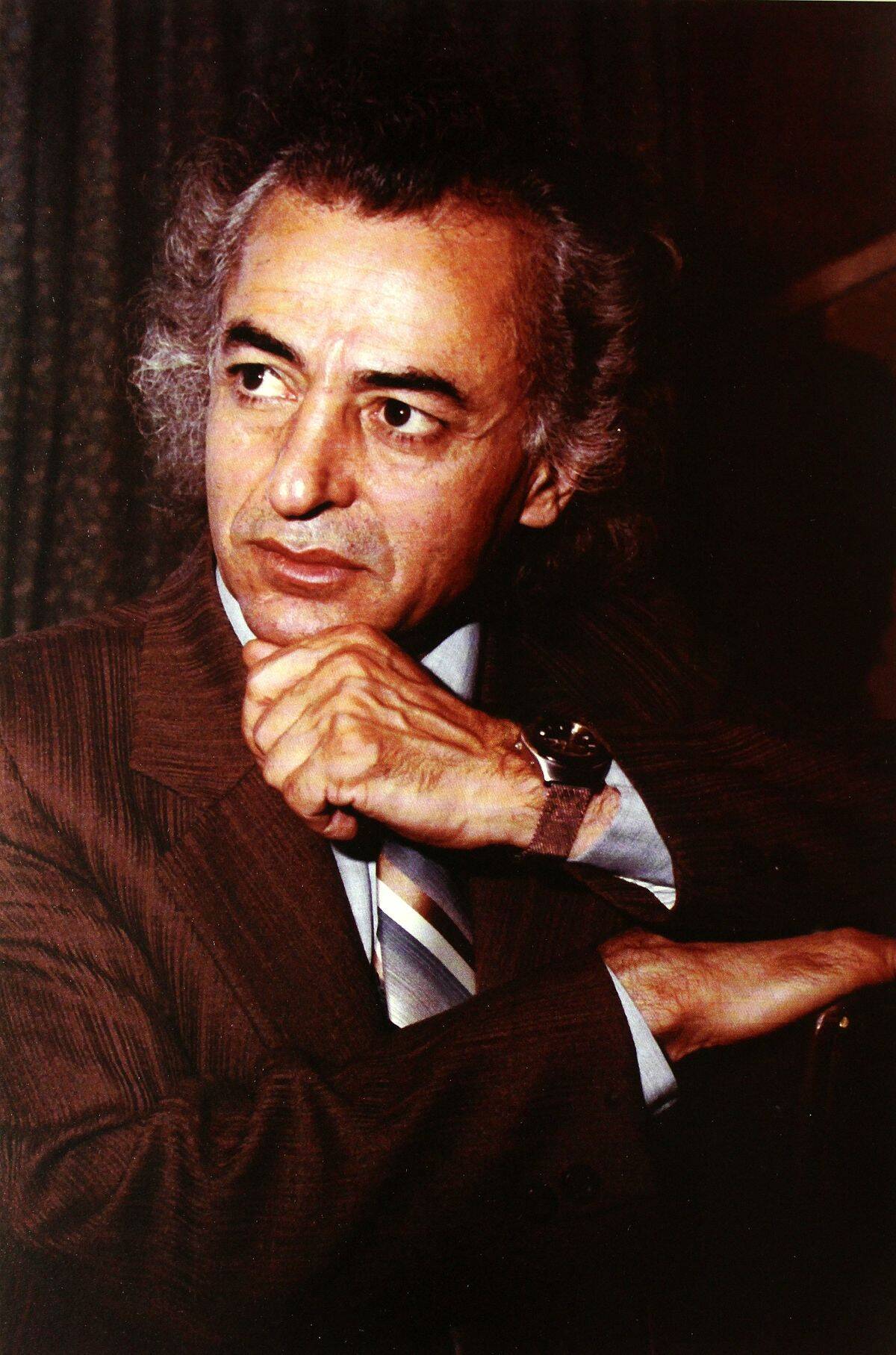
Vardges Petrosian was one of the remarkable authors of the group of “young prose-writers” in Armenia in the 1960s-1980s.
He was born on August 9, 1932, in the town of Ashtarak, where he spent his childhood, went to school, and began writing poetry. In 1954, he graduated from the journalism department of Yerevan State University and, after a stint as editorial secretary of the regional newspaper of Kamo (Gavar, 1954–1955), he worked as correspondent for the daily Sovetakan Hayastan (1955-1957) and as editorial secretary and later deputy editor of the bi-weekly Avangard (1957-1961). He was editor of the children weekly Pioner Kanch (1961-1966) and the founding editor-in-chief of the literary and youth monthly Garun.
After publishing a collection of poems, Ballad about Human Beings, in 1958, he went into prose. He is best known for the essay series Armenian Sketches (1969-1982), as well as the novellas Years Lived and Not Lived (1970), Pharmacy “Ani” (1973), The Last Teacher (1980), and the play The Hat of Hippocrates is Heavy (1975). Several of his works were adapted into plays. His novel The Solitary Walnut Tree (1981) was adapted into a film by director Frunze Dovlatyan in 1986.
The subject of most of Petrosian’s works, such as The Half-Open Windows of the City (1964) and Pharmacy “Ani,” was youth issues. His novel The Solitary Walnut Tree depicts the modern life and issues of mountainous villages. Armenian Sketches, his most noted work, is dedicated to the life and history of Soviet Armenia and the Diaspora and the importance of their connection. His articles, travelogues and literary reviews were published in the collection An Equation with Multiple Unknows in 1977. He published a two-volume collection of his selected works in 1983.
In 1975, Petrosian was elected first secretary of the board of the Writers’ Union of Armenia and served as its president from 1981 to 1988. Petrosian received the State Prize of Armenia in 1979 and was also honored with several decorations. He served multiple terms as a deputy in the Supreme Soviet of Soviet Armenia and then the Supreme Council of the Republic of Armenia, as well as the Supreme Soviet of the Soviet Union.
In 1994, he founded the newspaper Yerkir Nairi. He was assassinated on April 15, 1994, at the entrance of his building, and the crime has remained unsolved. The school No. 51 was named after him in 2000.