

News
Birth of Rafael de Nogales Méndez (October 14, 1877)

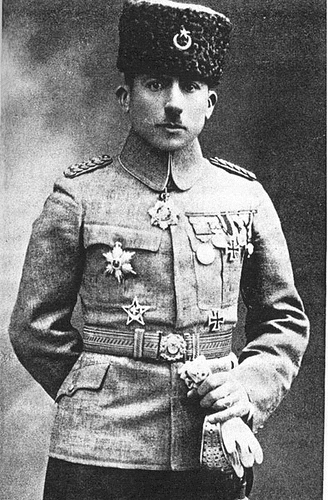
Rafael de Nogales Méndez was a soldier of fortune, adventurer, and witness of the Armenian Genocide.
He was born in San Cristóbal, Venezuela, on October 14, 1877. His father sent him to study in Europe, where he attended universities in Germany, Belgium, and Spain, and learned several languages. He was attracted to the military profession, and he began to travel where the news of war took him. He fought on the Spanish side during the Spanish–American War of 1898.
In 1902, he participated in a failed attempt to overthrow Venezuelan dictator Cipriano Castro involving an expedition aboard the schooner La Libertad. Two years later, he participated in the Russo-Japanese War as a double agent. He also spent time in Alaska during the time of the gold rush. He fought with the forces of Mexican revolutionary Ricardo Flores Magón in California and also worked as a cowboy in Arizona. He returned to Venezuela in 1908, after the military coup of Juan Vicente Gómez that overthrew his enemy Cipriano Castro. He supported Gómez, but had a fallout with him and went into exile.
When World War I began, Nogales unsuccessfully attempted to join a number of other European armies and ended by enlisting in the Ottoman army. He was assigned to the Caucasus army and sent to the Caucasus front. He led Ottoman gendarmerie troops into battle against the Armenian self-defense in Van, but asked to be relieved due to what he believed were “unjustified massacres of Christians” committed by Khalil Bey, uncle of Enver Pasha and commander of the Ottoman army. In 1924, he published Four Years Beneath the Crescent, his memoirs of his experiences with the Ottoman army. He recounted the massacres of Van during the Armenian genocide and wrote:
“At dawn I was awakened by the noise of shots and volleys. The Armenians had attacked the town. Immediately I mounted my horse and, followed by some armed men, went to see what was happening. Judge of my amazement to discover that the aggressors had not been the Armenians, after all, but the civil authorities themselves! Supported by the Kurds and the rabble of the vicinity, they were attacking and sacking the Armenian quarter, I succeeded at last, without serious accident, in approaching the Beledie reis of the town, who was directing the orgy; whereupon I ordered him to stop the massacre. He astounded me by replying that he was doing nothing more than carry out an unequivocal order emanating from the Governor-General of the province to exterminate all Armenian males of twelve years of age and over.”
He visited Diyarbekir in June 1915 and witnessed the massacres of Armenians there. His conversation with Governor Mehmed Reshid, the executioner of the Armenians of Diyarbekir, disclosed that the orders to massacre were sent by Talat pasha.
He was later transferred from the Caucasus to the Sinai and Palestine front, where he stayed until the end of the war. He was awarded the Iron Cross by Kaiser Wilhelm II.
After the end of the war, Nogales lived in London and New York. He cooperated with Nicaraguan revolutionary Augusto César Sandino and wrote several books of memoirs.
In 1936, he returned to Venezuela after the death of Gómez and was sent as commissioner to Panama to study the army of that country. He passed away in Panama City on July 10, 1937.