

News
DEATH OF KING LEVON V OF CILICIA (November 29, 1393)

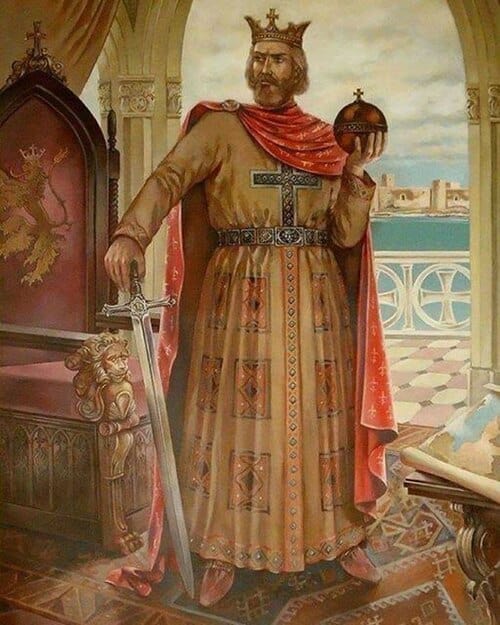
After an existence of almost three centuries, the Armenian state of Cilicia fell in 1375. Levon V was the last Armenian king.
The future king of Armenia, born in 1342 in Sis, was the younger son of Jivan Lusignan, grandson of King Levon III (1270–1289) and of a Georgian mother (or Armenian, according to some sources). His mother and her sons Bohemund and Levon escaped Cilicia in 1345 for Cyprus, fleeing the persecution of King Constantine II (1345-1363).
After the death of his brother Bohemund in 1359, Levon became a pretender to the throne. In 1374, with the support of Pope Urban V and the agreement of Catholicos Constantine V, Levon arrived in Cilicia and was crowned king on September 14, 1374, in the cathedral of Saint Sophia in Sis. However, his pro-Latinist policy was met with strong internal opposition by the anti-Catholic nobility.
Levon governed over a minuscule territory that included Sis, Anarzaba, and certain mountainous areas of Cilicia. The Mamluk Sultanate of Egypt would soon restart the hostilities and, after a three-month siege of the fortress of Sis, Levon was forced to surrender the fortress on April 13, 1375, which marked the fall of Sis and the end of the Armenian kingdom of Cilicia. Levon and his family, along with Catholicos Poghos I and several Armenian nobles, were captured and taken to Aleppo and then to Cairo. In July 1377, he met Franciscan monk Jean Dardel, who accompanied him as counselor, ambassador, and historian-biographer. The former Armenian king was held hostage in Egypt with his wife and daughter for seven years—both of whom died in the meantime—until he was ransomed by John I, King of Castile. In September 1382, he embarked from Alexandria for Europe, arriving in Spain in March 1383.
John I gifted Levon V the lordship of Madrid—which would become the capital of Spain in 1561—Villa Real and Andújar. He was also provided with an annual rent of 150,000 maravedis. He left in 1384 and went to Paris, where Charles VI of France gifted him the castle of Saint-Ouen and a sizable pension. He attempted to reconcile the French and the English, who were engaged in the Hundred Years’ War, to gain their support in recovering his kingdom, but the meeting he organized in 1386 was unsuccessful.
Levon V never recovered his throne and died in Paris on November 29, 1393. His remains were laid to rest in the convent of the Célestines, the second most important burial site for royalty after the basilica of Saint-Denis. The convent was desecrated during the French Revolution. His tombstone was recovered after the revolution and in 1815, a new cenotaph was established for Levon V at the royal Saint-Denis Basilica where most representatives of the French monarchy lie.
Levon V had one legitimate daughter, Marie de Lusignan (1370-1381), and two illegitimate sons, Guy de Lusignan (d. 1405), and Stephan.