

News
MESSAGE OF HIS HOLINESS ARAM I ON THE 111th ANNIVERSARY OF THE ARMENIAN GENOCIDE – REMEMBER, REMIND, AND DEMAND

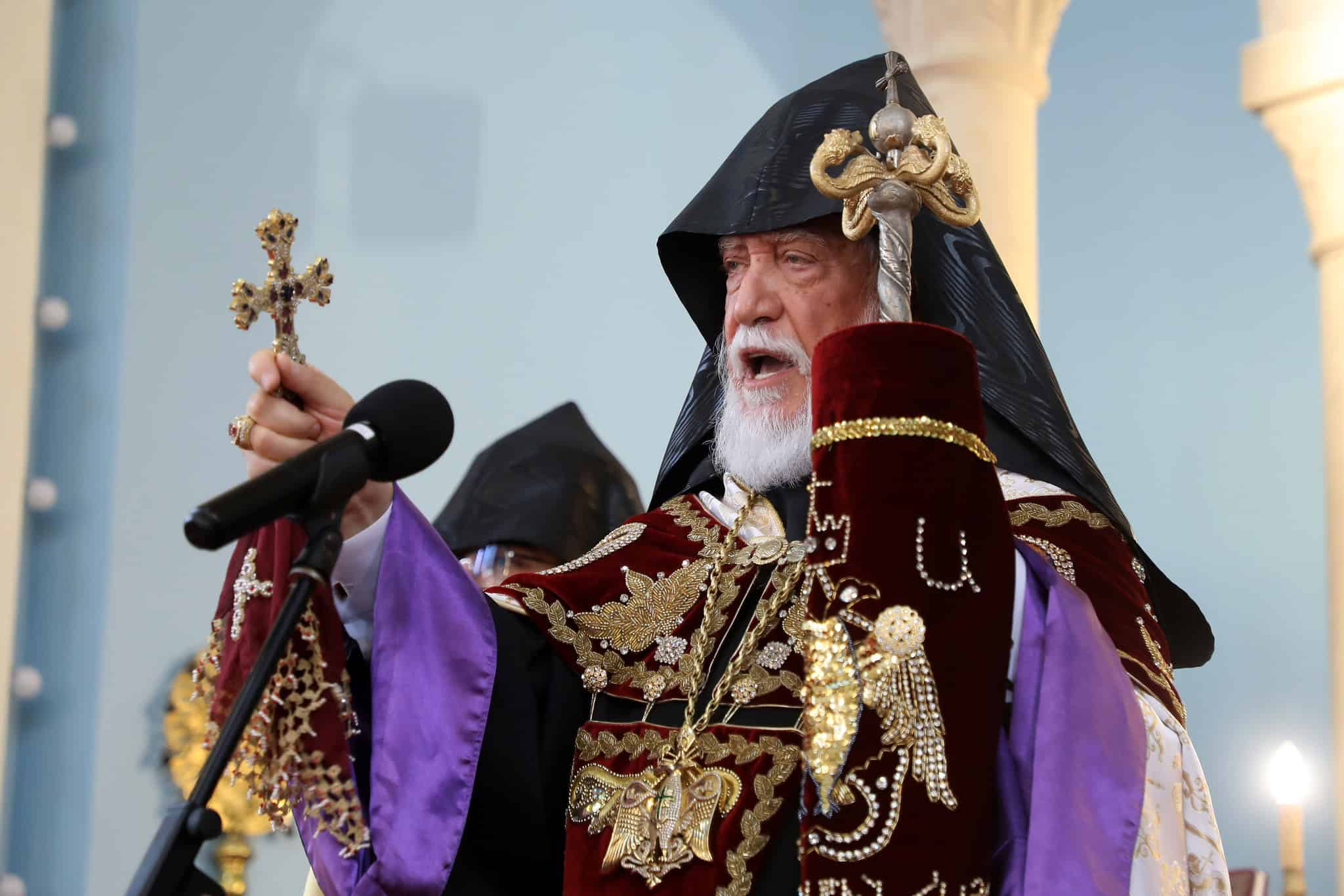
This text is an abridged version of the message of His Holiness Catholicos Aram I delivered on the evening of Thursday, April 23, in the courtyard of the Holy See in Antelias, during the public gathering held in front of the April Martyrs’ Memorial Chapel.
*****
Once again, the meaning and message of the Armenian Genocide pervades Armenian life everywhere. Indeed, however much the years may distance us from 1915, the Armenian Genocide will never fade from the collective consciousness of the Armenian people. However much time passes, the Armenian people’s pursuit of justice will not retreat in the collective struggle of future generations. The past 111 years speak to that. The firm will, resolute spirit, and unwavering struggle of the new generations speak to that.
As both the starting point and objective of the commemoration of the 100th anniversary of the Armenian Genocide, We had defined the slogan “Remember, Remind, and Demand.” Thereafter, the worldwide Armenian organization responsible for the centennial program chose “I Remember and Demand” variant. Nevertheless, We remained steadfast in Our principled position, because remembering, reminding, and demanding are closely intertwined, they are mutually complementary, and carry profound strategic meaning.
Therefore,
First: We shall continue to REMEMBER, however bitter the circumstances surrounding us may be—to remember the massacres of our fathers and mothers, the caravans of death, our martyrs left unburied on the sands of Der Zor, the slaughter of our intellectuals, the burning of our villages and their inhabitants, and our mothers and children drowned in the waters of the Euphrates. We shall continue to remember the genocide committed against the Armenian people from altars, pulpits, and stages, and within our families. We shall remember it everywhere that an Armenian breathes. Borrowing the words of the Psalm, I say: if I forget you, O Armenian Genocide, let my right hand wither, let my tongue cling to the roof of my mouth, if I do not remember you… (137).
This must become the vow of every Armenian. I do not believe that there is a single Armenian on this planet whose blood and consciousness are not imbued with the Armenian Genocide; otherwise, it is a denial of Armenian identity.
Second: We shall continue to REMIND the world of the first genocide of the twentieth century, committed against the Armenian people by the decision and planning of the Ottoman Turkish state. This is an undeniable historical fact. Indeed, hundreds of studies, publications, articles, and documents filling libraries and archives across the world—including those in Turkey—prove with solid historical grounding the genocide committed against the Armenian people.
Just a month ago, the Catholicosate published two studies in Arabic, prepared by a Sunni intellectual from Saudi Arabia and a Shiite intellectual from Lebanon, shedding light on the inner dimensions of the Armenian Genocide. Another study is currently in print at the Catholicosate, in Armenian and English, comprising two substantial volumes that include around three hundred eyewitness testimonies by foreigners who provided humanitarian aid to Armenians during the genocide and at the same time witnessed their horrific suffering.
Among the eyewitnesses, Maria Jacobsen, known as “Mama,” founder of the Bird’s Nest orphanage, testified: “I have seen with my own eyes the tragedy of the Armenian people; therefore, I cannot remain silent.” And she did not remain silent. I also wish to announce that a two-volume work entitled “Documents Related to the Depopulation of Cilicia” is currently in preparation.
Yes, we are obliged—through scholarly research and the powerful tools offered by modern technology—to remind everyone, including the new Turkish generation, of the Armenian Genocide. We must especially remind our own new generations, so that, equipped with historical, political, and legal means, they may demand justice for the terrible crime committed against their people.
Third: We shall continue, with renewed determination, our struggle for JUSTICE.
Alongside political and advocacy efforts, it is imperative, as we have often stressed, to enter the legal arena as well. You are aware that the first concrete step in this direction was taken by the Catholicosate of the Great House of Cilicia in 2014, by filing a lawsuit against the Turkish state and demanding the return of the Catholicosate of Sis. For more than ten years, we have pursued this case and are determined to follow it through at all costs. The file is now before Turkey’s highest judicial authority, to be followed by the Constitutional Court, and then we shall turn to the European Court of Human Rights.
Our Church, political parties, and Armenian Cause organizations have carried out immense work over the past decades in reminding, updating, internationalizing, and politicizing our violated rights. It is time, in light of the rapidly changing geopolitical conditions of today’s world and new developments in international relations, that the strategic and tactical approaches of our struggle for justice also undergo serious reassessment and reevaluation.
Fourth: It is necessary that the Republic of Armenia remain committed to the Declaration of Independence, which states: “The Republic of Armenia supports the international recognition of the Armenian Genocide committed in 1915 in Ottoman Turkey and Western Armenia” (Article 11). Likewise, the Armenian authorities must remain faithful to the Pan-Armenian Declaration of the 100th anniversary of the Armenian Genocide, which affirms the unified will of the Armenian people “to achieve worldwide recognition of the Armenian Genocide and the elimination of the consequences of the genocide…” (6), and calls upon Turkey “to recognize and condemn the Armenian Genocide carried out by the Ottoman Empire” (8).
These declarations are not mere words written on paper: they are VOWS, the first representing the will of the Armenian people from the platform of the National Assembly, while the second constitutes a nationwide vow made in the spiritual presence of our one and a half million martyrs at Dzidzernagapert. Therefore, the Armenian state must remain faithful to its vow. Let us be keepers of our covenant, not breakers of it.
In conclusion, we wish to emphasize that we reject any diplomatic or economic relations with Turkey and Azerbaijan that come at the expense of our fundamental national rights. The recognition of the Armenian Genocide and restitution of our violated rights by Turkey; the return of the people of Artsakh and the restoration of their autonomy with international guarantees; the protection of religious and historical monuments; and the release of Armenian prisoners in Baku by Azerbaijan remain our fundamental demands.
Thus, the slogan “Remember, Remind, and Demand” must become the guiding principle of our struggle for justice—at all times and under all circumstances—until the full restoration of our nation’s rights.
Prayer and reverence to our one and a half million canonized martyrs.
Honor and glory to our people, faithful to the sacred legacy of its martyrs.
CATHOLICOS ARAM I
OF THE GREAT HOUSE OF CILICIA
April 24, 2026
Antelias, Lebanon