

News
BISHOP SAHAG DISCUSSES COMMUNITY, DIALOGUE, AND FAITH IN MODERN TIMES

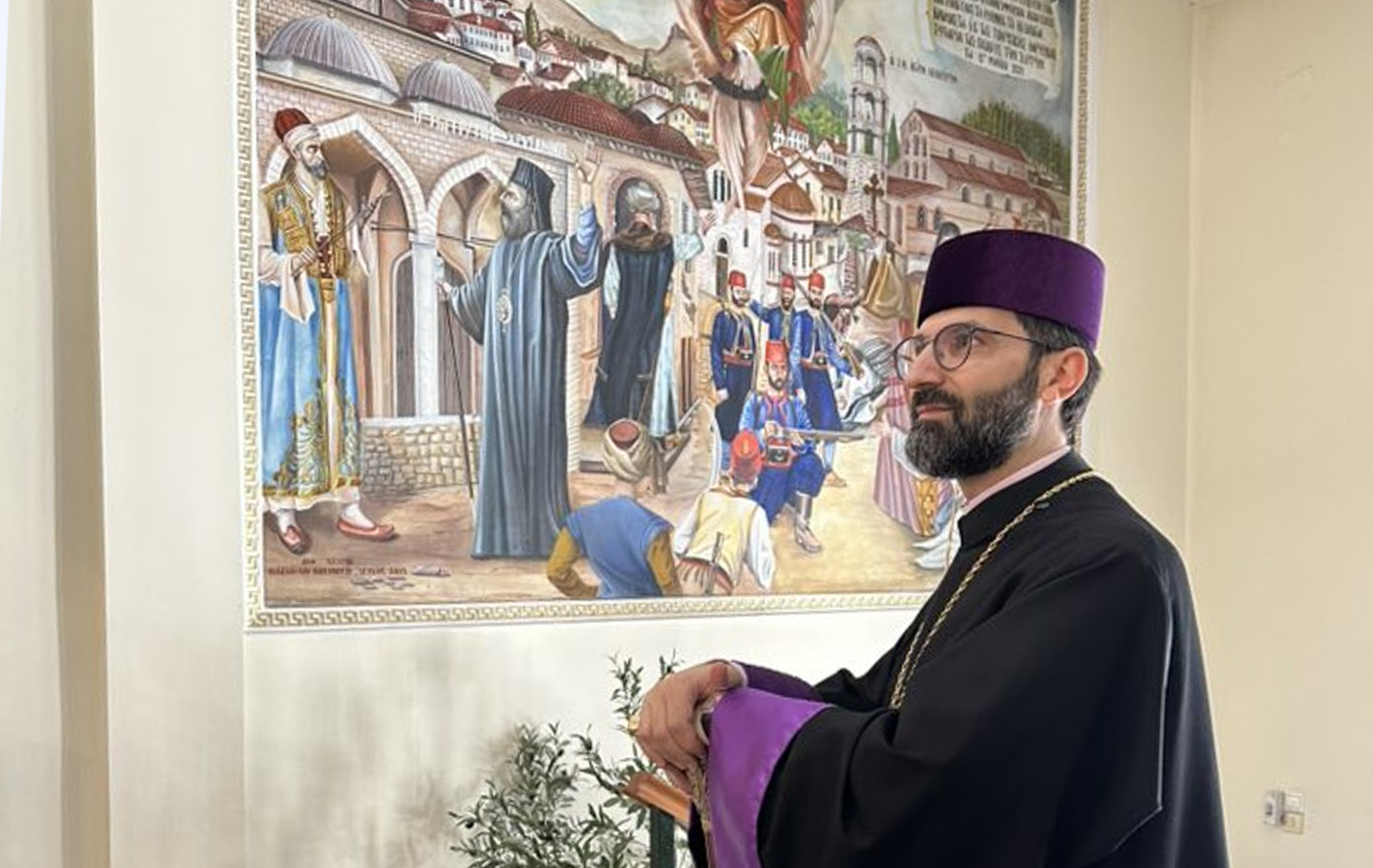
Crossroads interviewed His Grace Bishop Sahag, Prelate of the Armenian Prelacy of Greece, during his recent visit to New York, where he was received by His Eminence Archbishop Anoushavan, Prelate. Bishop Sahag Yemishian had served as Vicar prior to his current assignment, as well as Pastor at Sts. Vartanantz Church in Ridgefield, New Jersey In this conversation, he spoke about community life in Greece as well as relations with the Greek Orthodox Church and the challenges a fast-paced world poses for spiritual life.
How big is the Armenian community of the Greece and how is their condition?
The jurisdiction of the Armenian Prelacy of Greece includes twelve communities and ten churches. The Armenian community size is estimated at around 50,000-60,000. The main community arose from the exile in the years following the Armenian Genocide, but Armenians have been present in Greece, particularly in northern Greece, for some five hundred years. St. Kevork Church in Didymoteicho is believed to have been entrusted to the Armenians in the fifteenth century. This year marked the 150th anniversary of St. Garabed Church in Alexandroupolis. The Armenian community of Greece boasts a rich history.
Could you briefly describe the community’s institutional life?
In addition to its history, the community is also rich in institutions, organizations, and schools. Two elementary schools and one secondary school operate on a daily basis in Greece. The daily newspaper Azad Or is published within the community. The Armenian Blue Cross, Hamazkayin, Homenetmen, and the Armenian Youth Association are all actively engaged in the community life.
How are relations between the Armenian and Greek Orthodox Churches?
Relations between the Armenian and Greek Orthodox Churches are very positive and operate at a high level. Their close ties are evidenced by the honor shown to His Holiness Catholicos Aram I with the release of his book “The Armenian Church” in Greek last year. It was translated and published by the publishing house of the Greek Orthodox Church and presented at a special public event. Historically, the Armenian Prelate has maintained close personal and official relations with the Greek Church. Efforts are made at every level to establish constructive relations with religious and political leaders of Greece. Naturally, these meetings and discussions are focused on the Armenian community of Greece, particularly regarding the educational and spiritual life of Greek Armenians, the enhancing of ecumenical dialogue, the organizational needs of church life, the appreciation of the historical Armenian presence in Greece, the preservation and restoration of the Prelacy’s historic churches, as well as the deepening of cooperation with the Hellenic Republic in support of communal stability and peaceful coexistence.
The distancing of a segment of the Armenian people from the Church, particularly in the Diaspora, is a reality. The same is observed throughout the Christian world. Hence the question: Are people moving away from the Church, or is the Church distancing itself from the people? Or are both things happening at the same time?
This is an important question, and one could say that both are happening simultaneously. To answer it properly, however, a few clarifications are in order.
It is evident that people have, to some extent, distanced themselves from the Church. There are several reasons for that: globalization, secularization, the fast pace of life, the diversification of interests, and the culture of instant access and speed at the touch of a finger. Faced with all that, understanding how or why the Church has “moved away,” we must examine the Church’s place and approach to these challenges.
We know that the Church is the collective body of the people. As such, it stands on three main pillars: doctrinal, liturgical, and administrative. The doctrinal pillar is immutable; the liturgical and administrative pillars have adjusted to changing circumstances and have undergone modifications. Today, the Church is taking steps toward the people via liturgical and administrative adaptations, but it is also obvious that people are increasingly moving at a quicker pace on a daily basis. Therefore, the Church is not voluntarily distancing itself from the people, but the speed of things and diversity in the modern world tend to create a gap between the Church and the faithful. Nevertheless, the Church continues to be close to the people and keep pace with them. Today, the Church is not confined within its walls, and considerable efforts are made to be present in the daily lives of the faithful. At the same time, our people should not consider themselves apart from the Church or as a separate party. The Church is the house of God, but it is also the home of all of us, for we are all children of God.