

News
Birth of Ghevont Alishan (July 6, 1820)

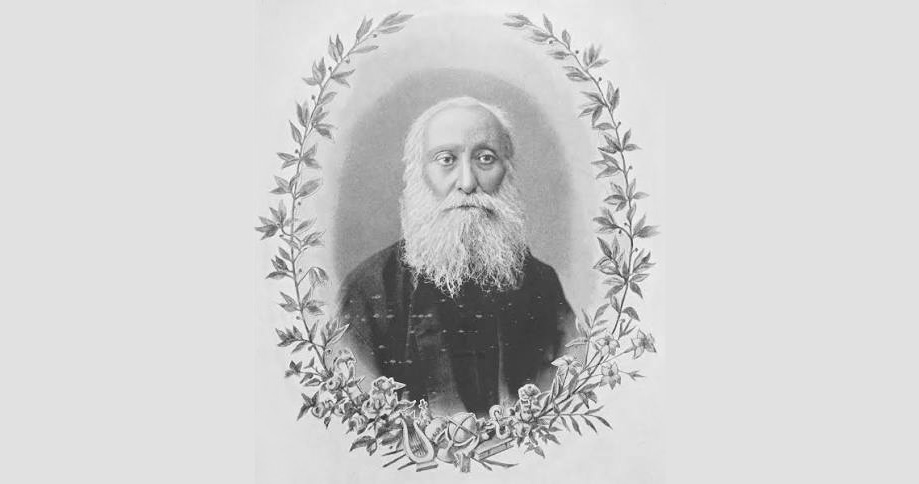
Father Ghevont Alishan was one of the foremost names in nineteenth century Armenian scholarship and literary history. He authored several mammoth books on Armenian history, archaeology, and geography, which are still regarded as precious primary sources.
He was born Kerovpe Alishanian in Constantinople on July 6, 1820, into the family of Bedros Alishanian, an antiquarian and numismatist. He studied at the Chalekhian school (1830-1832) and then at the seminary of the Mekhitarist Congregation in Venice (1832-1841). In 1841-1850, he taught at the Moorat-Raphaelian School of the congregation, in Venice, and became its principal in 1848. He started to contribute his poems to the flagship journal of the Mekhitarists, Bazmavep, of which he was one of the founders in 1843. The Italian rebellion against Austrian rule in 1848, as part of the revolutionary movement that exploded throughout Europe, fired his imagination. He wrote several patriotic poems, of which the most famous was the one dedicated to Vahan Mamikonian (nephew of Vartan Mamikonian, the hero of the battle of Avarayr) that starts with the words Բա՛մբ, որոտան… (Pamp, vorodan… “Ring out, trumpets!”). It would become a celebrated patriotic march, an unofficial Armenian hymn through the first decades of the twentieth century.
Between 1850 and 1853, Alishan visited important European cities, such as Rome, London, Paris, Berlin, and Vienna, where he studied Armenian manuscripts and cultural artifacts, and gathered materials for his future investigations. During his journey, he translated the fourth canto of Lord Byron’s famous poem, Childe Harold’s Pilgrimage.
He became the principal of the Samuel Moorat College of Paris in 1858-1861 and then returned to San Lazzaro, taking again the helm of the Moorat-Raphaelian School in 1866-1872. Afterwards, he abandoned the educational field to concentrate on Armenian Studies until his death on November 8, 1901.
He was one of the pioneer names in Armenian romantic poetry and his works, written between 1840 and 1852, were collected in five volumes published in 1857-1858. Most of those poems, however, were written in classical Armenian (krapar) and remained inaccessible to the public in general. He became celebrated for a small collection of works written in modern Armenian (ashkharhapar) between 1847 and 1850.
His main contribution to Armenian culture was his huge scholarly work. He carried out a methodical plan of collecting information and systematically reconstructing Armenian antiquity. His poems and his works made him a household name. He never set foot in Armenia, but his extensive research was famous for its geographical accuracy. He wrote about Armenian ancient and medieval history, literature, mythology, and other issues. Some of his most important works are Nerses Shnorhali and His Family (1873), Shirak (1881), Sisuan (1885), Ayrarat (1890), Sisakan (1893), Ancient Belief or Armenian Pagan Religion (1895), and Armenia and Venice (1896).