

News
“THE BIRTHPLACE OF OUR SOULS”: THE PRELATE’S MESSAGE TO THE NATIONAL REPRESENTATIVE ASSEMBLY

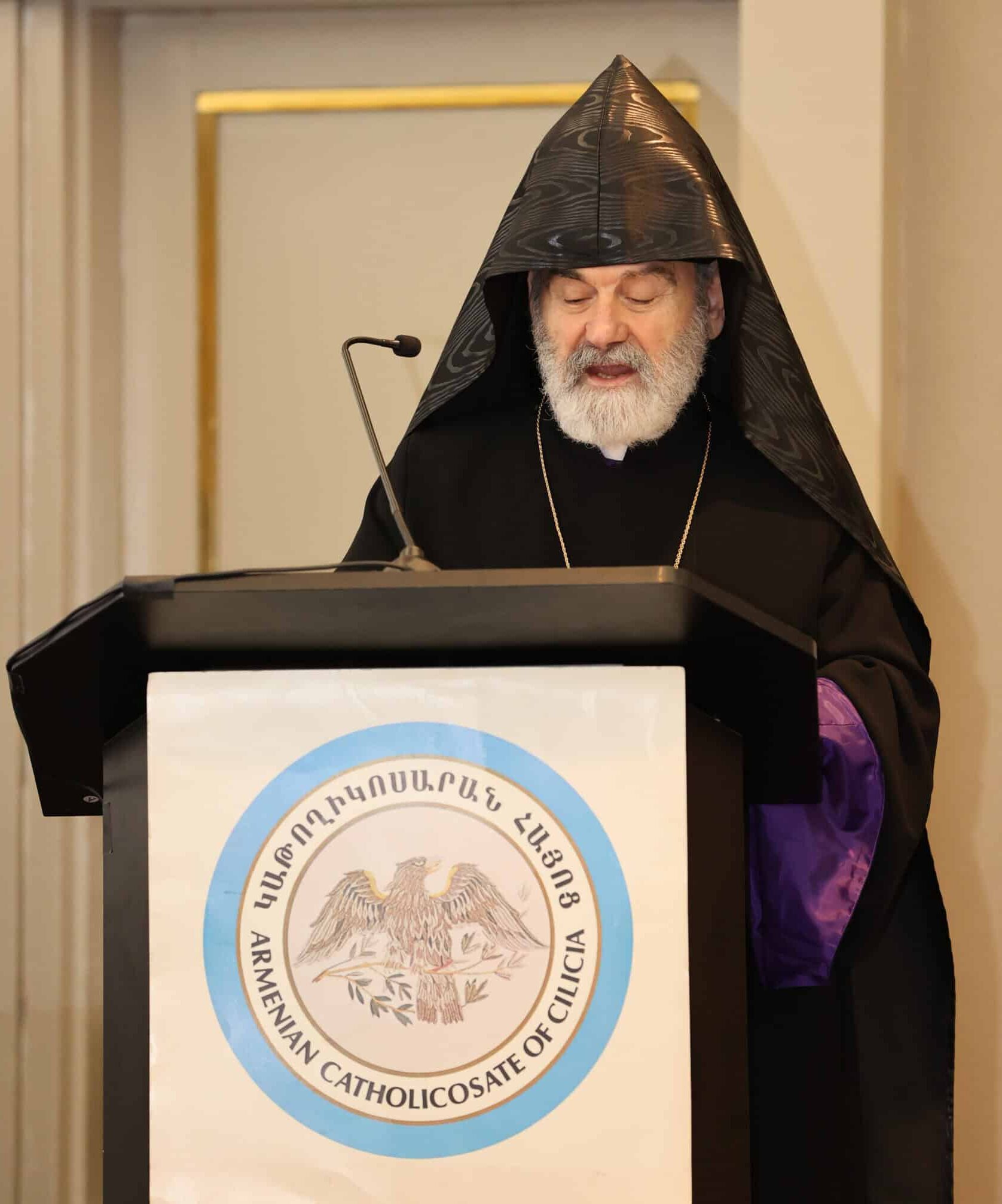
Dear delegates and guests,
I am pleased to greet you as we open the 2026 National Representative Assembly, graciously hosted by Saint Sarkis Church. We are gathered as the extended family of the Eastern Prelacy, under the jurisdiction of the Holy See of the Catholicosate of the Great House of Cilicia, to celebrate our oneness in our Armenian Christianity, to review our joint and collective achievements, and to share our vision toward a more productive future.
I would like to thank the Almighty Lord for providing us with visible and invisible bounties, thus enabling us to fulfill our service, to reorganize ourselves, and to extend our outreach. I would like to express my filial respect to His Holiness Catholicos Aram I, who is exercising praiseworthy leadership during this critical period in the history of mankind. My heartfelt gratitude goes to all my colleagues: the Religious and Executive Councils, the Pastors, the NRA Delegates, the Boards of Trustees and parish auxiliary bodies, sister organizations and faithful at large, in fulfilling our collective dreams full of faith, hope, and love.
I would like to offer special thanks to all our community leaders and congregations for warmly welcoming the Pontifical visits of His Holiness Catholicos Aram I in 2023 and 2024, and last year for celebrating his 30th anniversary of election and ordination as Catholicos. His Holiness assumed this sacred yoke at a critical time when, unfortunately, false rumors were prophesying the end of the Catholicosate of the Great House of Cilicia. We are immensely grateful that under the leadership of His Holiness, the Holy See has not only continued her mission but has enlarged it to explore the depth and the height of our service and to actualize it on domestic as well as international levels. Upon his return to Lebanon, having witnessed the vibrant cultural, social, philanthropic and, above all, the spiritual life in our communities, His Holiness was moved to declare 2026 “the year of Spiritual Revival.” I would like to make this theme the core of my reflection. I would like to take a more pragmatic approach, away from its obvious transcendental dimension, and make the concept of spiritual renewal more relevant to us, even as we are heavily burdened with the challenges of this century.
Through my half century of experience in the Diakonia of the most revered Body of Christ, the Church, I have discovered that Spirituality is like solar power. Diakonia (or “ministry”) makes us, as the stewards and even co-workers of Almighty God, more clearly goal-oriented, energetic, positive, and productive, with a holistic understanding that embraces all Creation.
There is no doubt that faith essentially is the source through which humans enjoy the Divine goodness on earth, while remaining in union with our Heavenly Father in spirit. Yet this experience may manifest itself in different forms. A brief overview of our history testifies that our faith, while showing a beneficial vertical communication with the Living Almighty God, has impacted most aspects of our life. The conversion of Armenians to Christianity was marked not only by the adoption of religious and liturgical beliefs and practices, but also by the phenomenal transformation of Armenian life, witnessing the building of schools, charitable institutions, hospitals, and centers for those marginalized and rejected by the society, i.e. lepers, etc. This milestone was continued after the invention of the Armenian alphabet in 405 with the crystallization of our identity, and moreover, with the creation of a rich cultural heritage through the following centuries, which attracts scholars from different parts of the world to this day. This process of faith galvanizing our uniqueness was put to the test in 451 when a nation ready to be sacrificed boldly declared in the footsteps of Saint Paul, paraphrasing the Apostle, “Nothing can separate us from our faith, neither death nor life, neither angels or demons, neither our fears for today nor our worries about tomorrow….” (Rom 8.38-39), thus cementing our faith as unshakable as Mount Ararat.
Over the centuries, living faith has been manifested by carving crosses and providing them with a mystical language to praise the Creator. It has shaped architecture to build churches with a unique cross-form design to remind all those who enter the church of heavenly love. It has inspired scribes to illuminate their manuscripts even in times of calamity. The masterpieces of Toros Roslin, Sarkis Bidzag and others charm contemporary artists with their lively colors. It has encouraged spiritual leaders, such as Catholicos Hovhan Otznetzi of the eighth century, to undertake a long journey to Damascus to meet Caliph Omar to liberate Armenia from the heavy yoke of persecutions and taxation, as well as Catholicos Nerses the Graceful, who initiated ecumenical dialogues for peace in the twelfth century with Byzantine Emperor Manuel Comnenus.
This living faith has amazingly linked the peasant with the soil. Khrimian Hayrig, the Catholicos of All Armenians well known for his patriotic devotion, is a role model to all environmentalists who warn us to take care of Mother Nature. In his book “Babig yev Tornig” (Grandfather and Grandson), the grandfather enthusiastically teaches and transfers centuries-old family values and the peasants’ love and care toward the homeland soil to his beloved grandson. Gomidas Vartabed, a victim of the Armenian Genocide, revealed another dimension of this legacy in the peasant song “Horovel.” A very innocent yet heart-touching song, a conversation between the peasant and his ox, when the former shares his joy with the latter, greeting the first light of sunrise and encourages his coworker to plow open new rows in the fertile soil.
Spirituality has manifested itself in different forms not only in the life of those who were privileged to be born and raised over thousands of years on the Armenian Plateau but also in our young generation born and raised in the Land of the Free. A most recent experience which I would like to share with you took place on April 24 in Greater Philadelphia. I was stunned to see the modest garden of Young Meher’s statue located next to the Philadelphia Museum of Art transformed into a meticulous fulfillment of a long-cherished dream, full of symbolism. The Heritage Walk has been designed to illustrate the resting place of Noah’s Ark on Mount Ararat. The length of the Heritage Walk averages 301 feet and reminds us of the historical date of the conversion of Armenia to Christianity. The design includes dimensions and proportions with digital roots of three, referencing the Holy Trinity interlaced into the Armenian Heritage Walk’s flowing passage. The collection of stones, flowers and bushes has been imported from the land of Armenia, from where the Euphrates and Tigris Rivers flowed out, irrigating the Biblical Eden. Truly I called this monumental achievement the incarnation of the free and glorious Armenian spirit soaring above the land of the Free.
We should be so thankful to the Almighty Lord that He has led us to be part and parcel of His Body, the Apostolic, Orthodox, Universal Church. We should be so thankful to God who has offered us the Armenian Church, in the words of prominent poet Vahan Tekeyan, to be “the birthplace of our souls” where all these treasures have been preserved over centuries, thus making the Church not only the birthplace, but also as the same poet says, “the armor of my soul.”
What a prophetic voice! The Church has been regarded as the armor of our souls and identity not only by our people but also by non-Armenians. Indeed, last year the world became a witness to the statement by our neighboring country’s religious leader that “the Armenian Church is an obstacle in the region to establish peace.” This statement makes it clear that not only in antiquity but also in modern times the Church has been interpreted as the ultimate fortress of our existence. Following this declaration, unfortunately, under the pretext of targeting the Catholicos of All Armenians and high-ranking clergy, a blind, furious, and violent persecution has been instigated by the Armenian government to weaken the twenty-century- old Armenian Church and to subjugate her to the capricious will of secular authorities. This is an existential wake-up call for all of us to mobilize all our organizations around the Church to face present and future challenges.
The Armenian Church in Armenia and throughout the Diaspora, under the guidance and renewing power of the Holy Spirit, pursues the role entrusted to her to remain faithful to her roots and divine ordinance, teaching the values of the Holy Scriptures as well as promoting spiritual life in its manifold expressions, anchored in the Love manifested on the Cross.
Part of that role is manifested by our continuing projects, such as the St. Gregory Datev Summer Institute, Salt and Light Youth Mission, College Ministry, Bible studies, Great Lent lectures, the Saints Sahag and Mesrob Institute, for community education and preparation of clergy, the Center Prayer program, the Prayer with the People, daily Bible readings, educational pamphlets and booklets, among other initiatives. Last but not least, spirituality in action is represented by our charity projects in Armenia, Lebanon, and Syria.
Therefore, joining my feeble voice to the Pontifical message, I beseech you all, as the ambassadors of this august body, upon returning to your respective communities, to kindle the hearts of your co-parishioners, diligently and zealously, with the message of spiritual renewal. We should all, as the Prelacy, churches, and sister organizations, promote a spiritual spring in our families and communities. I am so thankful that in September of this year we will be celebrating the 40th anniversary of the Datev Institute, and God willing next year the 10th anniversary of the Salt and Light youth ministry. I feel so grateful when I see so many young people flocking to serve in our parishes. My heart breaks out in tears of joy when in different churches I see the youth on the altar, who immediately after the Badarak continue their dedication as members of church boards or sister organizations like Homenetmen or AYF, sharing the responsibility for taking care of the congregation during fellowship hour and banquets.
Following our Pontiff’s invitation, let us all celebrate this year saying with the Psalmist, “This is the day that the Lord has made. We will rejoice and be glad in it” (Ps 118.24). Let us celebrate not only with our lips, but through our daily actions by bringing our Heavenly Father into our families, by meeting every Sunday our Lord and Savior Jesus Christ at our collective house, the Church, and by renewing ourselves in the power of the Holy Spirit in our pilgrimage from life to Life, always being thankful for His providential care on Mankind, in general, and for our nation, in particular.