

News
Death of Lili Chookasian (April 9, 2012)

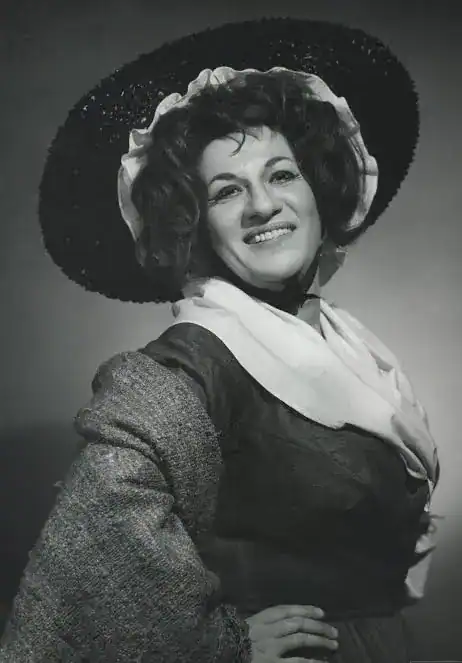
Lili Chookasian became an acclaimed opera singer after she started singing opera in the late 1950s, rising as one of the world’s leading contraltos during the 1960s and 1970s.
She was born in Chicago on August 1, 1921, the youngest of three children, to a family of survivors from the Armenian Genocide. Her first language was Armenian, as her parents spoke that language at home. She only became proficient speaking English through school.
Chookasian first became involved with music through singing at local churches and in musical programs at her high school. After high school she began studying and took lessons for almost twenty years. In her late teens, she started earning money singing for churches and on the radio. In 1941, she married George Gavejian and had a marriage that lasted for forty-six years, ending with Gavejian’s death in 1987. They had several three children and eleven grandchildren.
Lili Chookasian began performing professionally as an oratorio and concert singer in the 1940s, mostly in Chicago but also occasionally out of town. The biggest triumph of her early concert career was in January 1955 as contralto soloist for Mahler’s Symphony No. 2, “Resurrection” with the Chicago Symphony Orchestra directed by Bruno Walter.
In 1956, Chookasian was diagnosed with breast cancer and her physicians gave her six months to live. She fought her illness and underwent a radical mastectomy, and with continuous medical attention and the support of her family she prevailed and her life slowly returned to normal. She overcame a second cancer bout in 1961, going through another mastectomy.
In 1959, she made her opera debut as Adalgisa in Bellini’s “Norma” with the Arkansas State Opera. Her performance was a resounding success and in 1961, after working with the Baltimore Opera Company, she made her New York Philharmonic debut in the role of Amelfa Timoferevna in Tchaikovsky’s “Alexander Nevsky.”
Shortly thereafter, Chookasian was offered a contract with the Metropolitan Opera but turned down for fear that it would take too much time away from her family. In the summer of 1961, she made her opera debut in Europe. After returning to the United States, Chookasian finally joined the Met in 1962. During her 24-year-long career, she sang many principal contralto roles and a number of secondary parts with many great singers from Birgit Nilsson to Plácido Domingo. After suffering a minor heart stack on stage in 1984, her performance career slowed down and her last performance at the Met was on February 17, 1986, which was her farewell to the opera stage.
She sang in opera houses both in the United States and Europe. She quickly became one of the leading contraltos performing on the international stage during the 1960s and 1970s, singing under many great conductors like Herbert von Karajan, Georg Solti, Zubin Mehta, Lorin Maazel, Seiji Ozawa, Leonard Bernstein, and others, with such ensembles as the Philadelphia Orchestra, the London Symphony Orchestra, and the Vienna Philharmonic among others. She was particularly admired worldwide for her performances in Beethoven’s Symphony No. 9, Mahler’s “Das Lied von der Erde,” Schoenberg’s “Gurre-Lieder,” and above all Verdi’s “Requiem.” She recorded these and many other words. She performed in many world-class stages such as the Bayreuth Festival, the New York City Opera, the Opéra de Montréal, the San Francisco Opera, and in many other venues of the United States and Europe.
Lili Chookasian fondly recounted one of her most memorable trips to Yerevan in an interview of 1997. She was invited to the city to perform in two productions mounted in her honor: Verdi’s “Aida” and Dikran Chukhajian’s “Arshak II.”
After retiring from the stage in 1986, Chookasian joined the voice faculty at the School of Music of Yale University and moved to Branford, Connecticut. She was awarded Yale’s Sanford Medal in 2002.
She died in Branford at the age of 90 on April 9, 2012.